Guide DigFair · 18 oct. 2026
Buy PTC Traffic for Crypto Sites Without Losing Your Focus
Understand PTC visit lengths, traffic quality, network frequency limits, and a simple measurement plan before funding your crypto project campaign.
Paid-to-click advertising sells a defined viewing opportunity, not a committed customer. Someone may complete the required visit and leave; another may decide the offer is worth returning to later. That distinction matters when you buy ptc traffic for a faucet, game, or crypto tool. The objective is not merely to collect the highest possible counter. It is to give suitable visitors enough context to take a next step that you can measure. Start with one offer, a direct landing page, and a small experiment whose result you can explain.
Understand what a counted visit represents
A PTC visit typically requires a viewer to remain for a selected duration. It does not mean the visitor has registered, understood the product, or agreed to receive messages. Compare campaign delivery reports with on-site analytics, but expect the two systems to count different events. Ad delivery measures fulfilled visits under the campaign's conditions; site analytics may measure sessions, page loads, or consented tracking events. Differences should trigger an investigation, not an automatic claim of fraud.
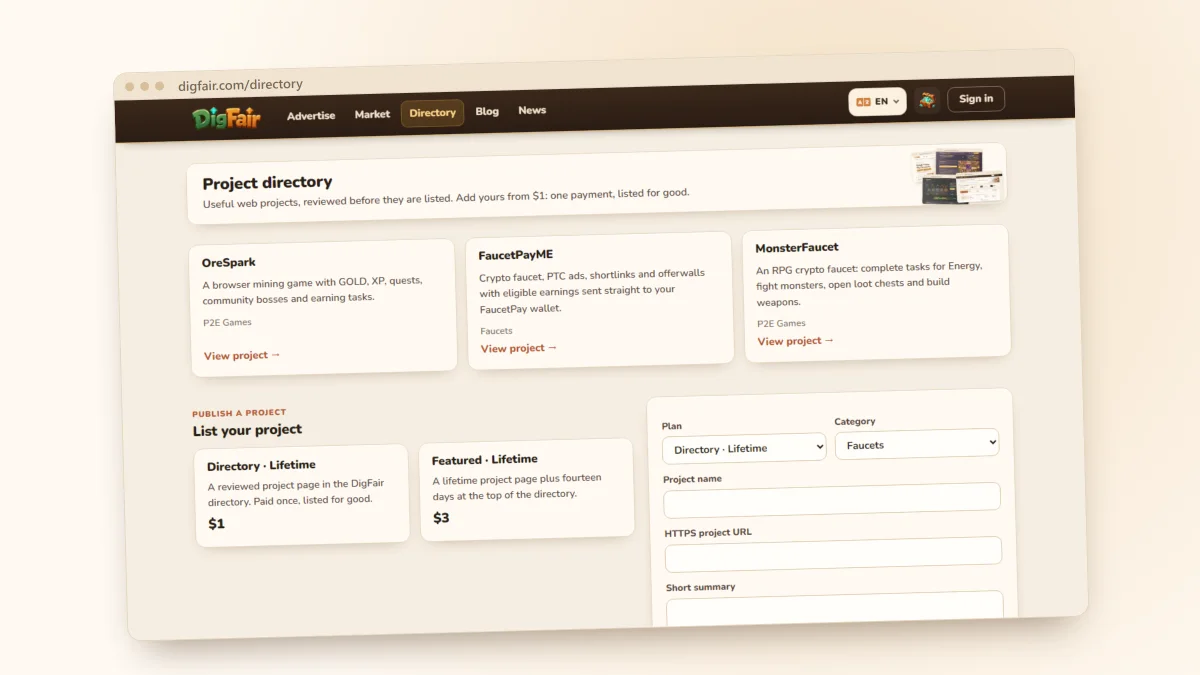
DigFair's Ads Market serves one campaign across DigFair, FaucetPayME, MonsterFaucet, and OreSpark. A member can contribute one visit every 24 hours across the entire network for that campaign. This network-wide frequency rule helps frame reach, but it does not promise unique buyers or a particular conversion rate.
Match timer length to the explanation your page needs
DigFair lists these PTC options per 1,000 visits: five seconds at $0.35, ten at $0.50, thirty at $1.25, sixty at $2.25, and 120 at $4.00. A short placement can test whether a headline attracts curiosity. A longer duration may make more sense when a product needs reading time, although remaining on a page is not the same as attention. Choose the shortest duration that permits a visitor to understand the single action you want.
For example, a giveaway announcement with a clear deadline may require less explanation than an RPG faucet with equipment and energy mechanics. MonsterFaucet is a relevant network example of a game-style crypto faucet, where a landing page should orient new players before asking them to join.
Build a destination that can convert a brief visit
Put the offer in the first visible screen. State what the product does, what the person must do, and what they will see after the click. Avoid an automatic redirect, a stack of popups, or a claim that rewards are guaranteed. These tactics may increase accidental interactions while weakening trust. For mobile visitors, compress large images, simplify registration, and check that all buttons remain visible without horizontal scrolling.
Give campaigns their own tracking parameters and record the final destination before approval. Because DigFair reviews campaigns before they go live, prepare ad wording and the destination together. A mismatch between the ad's promise and the landing page wastes visits regardless of the traffic source.
Run a measurement exercise instead of guessing
- Choose one goal, such as completed signups or an engaged second page view.
- Record the original page and its conversion rate before promotion.
- Use one campaign URL with a dedicated tracking label.
- Inspect delivered visits in each site's Campaigns report.
- Check real on-site outcomes, excluding your own test traffic.
- Change one variable at a time: audience message, timer, or landing page.
If you cannot distinguish registered users from page visitors, fix measurement before buying more exposure. A simple table with date, campaign cost, delivered visits, genuine registrations, and returning users is enough to spot early patterns.
Use a cost-per-outcome worksheet rather than a cheap-visit ranking
A quoted cost per thousand visits can be compared across viewing lengths, but its economic meaning changes if the landing page and user behavior change. Suppose one placement brings a large number of arrivals and few completed introductions while another brings fewer arrivals but clearer engagement. The second result may justify further investigation, even if its unit price is higher. Record campaign spend, eligible delivered visits, registered accounts, and genuine returns in separate columns. Only calculate cost per action once the action definition is consistent across tests.
Remember that exposure is not necessarily a unique new person over the life of every campaign. The network's once-per-24-hours rule for each member and campaign controls frequency but does not provide a complete identity profile or demographic targeting claim. Choose a realistic review period and note weekends, major site changes, and temporary outages that affect comparability.
When numbers are modest, favor qualitative evidence too. Watch where a tester gets stuck, ask a new user what they thought the advertisement offered, and read support questions submitted after the campaign. If the ad attracts people who expect a feature the site does not provide, the most useful fix may be a more precise headline, not a longer timer. Treat those observations as hypotheses for the next controlled test, rather than guaranteed predictions.
When expansion makes sense
DigFair's advertising marketplace offers PTC campaigns alongside banners and other formats. The first PTC or banner campaign receives doubled views, capped at $5 in additional value; confirm the current terms before planning a test. Treat the bonus as extra distribution, not extra revenue. Expand only when the experiment supports a clear learning or business objective. Buying larger volumes against an unclear offer usually makes the ambiguity more expensive, not more informative. If you buy ptc traffic again, use the first campaign's visitor behavior to decide what specifically needs changing.